

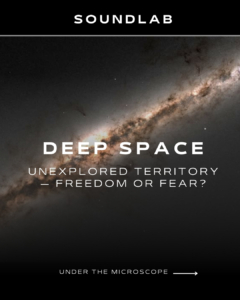
SOUNDLAB // Deep Space
Unexplored Territory — Freedom or Fear?
Deep space is the ultimate projection surface.
We look up and see distance, darkness, silence, the promise of discovery — and the threat of getting lost. We talk about exploration in technical terms: navigation, signals, propulsion, life support. But somehow, the moment we say “deep space,” something emotional slips into the room.
Because deep space isn’t only a place on a map.
It’s a state.
And here’s our Soundlab stance: everything we can observe on a macro scale, we can also find on a micro scale. Like fractals — the same patterns repeating, differently sized. The cosmic and the personal aren’t opposites. They’re reflections.
So when we put DEEP SPACE under the microscope, we’re not only asking what’s “out there.”
We’re asking what the unknown does to the human nervous system — in the universe and in everyday life.
No final answers. Just a lens.
The rest is yours.
The Pull of the Unknown
Why does unexplored territory feel like freedom and fear at the same time?
Maybe because “unknown” carries two promises at once:
-
Possibility: new worlds, new meanings, new versions of self.
-
Risk: loss of orientation, loss of control, loss of the familiar.
Deep space seduces us with expansion — and confronts us with exposure.
And if we’re honest, we don’t only experience this in galaxies.
We experience it on Mondays. In relationships. In decisions we postpone. In creative leaps. In the moment right before we press “send.”
The macro drama becomes micro-real.
Freedom vs Fear: a false binary?
We love binaries because they feel safe:
good/bad, progress/danger, courage/avoidance.
But deep space doesn’t fit into clean boxes — and neither does a human life.
Freedom can be terrifying.
Fear can be protective.
Curiosity can be self-trust.
Curiosity can also be self-sabotage.
So instead of choosing a side, we’re interested in the field between them.
A few questions to sit with:
-
Is the unknown an invitation… or a warning?
-
When does exploration become exposure?
-
Does freedom require losing control?
-
Are we afraid of the void — or of what we might become inside it?
If you notice your mind trying to resolve these too quickly: good.
That tension is the point.
No Map. No Signal. No Reference Point.
In space, orientation depends on reference: coordinates, instruments, external signals. Without them, even movement becomes confusing. You can be traveling fast and still feel motionless. You can be “on course” and still feel lost.
Now shrink that down to the micro scale:
How often do we measure our lives by external signals?
-
feedback
-
validation
-
certainty
-
the “right” timeline
-
other people’s reactions
-
the illusion of a guaranteed outcome
When those signals disappear, the same question appears — whether we’re in a cockpit or in a kitchen at 2 a.m.:
What do I trust when I can’t verify?
Getting lost isn’t only a location problem.
It’s a perception problem.
The Mirror Theory: Deep Space as Inner Space
Maybe deep space isn’t empty.
Maybe it’s a mirror.
A place where everything non-essential drops away: noise, status, distraction, performance. What remains is the raw material we usually avoid: uncertainty, vulnerability, the need to decide without full information.
This is where macro and micro start to rhyme.
Deep space doesn’t just challenge technology.
It challenges identity.
Because when you remove reference points, you don’t only lose direction — you also lose the story you tell yourself about who you are.
And then a different kind of navigation begins.
Not GPS.
Not certainty.
Something quieter: intuition, sensation, meaning.
A multisensory compass.
Fractals: the big pattern in the small day
Fractals are patterns that repeat across scales. Coastlines. Snowflakes. Storms. Branches. The same geometry, over and over, differently sized.
That’s our favorite metaphor for deep space — because it reframes “the cosmos” as something intimate.
If the pattern repeats, then the questions repeat too:
-
How do we explore without conquering?
-
How do we stay curious without burning out?
-
How do we risk without collapsing?
-
How do we move forward without a guarantee?
Maybe “deep space” is less about distance — and more about the relationship between control and surrender.
From Inquiry to Sound: Space Dive
This Soundlab theme didn’t start as a concept deck.
It started as a feeling that wanted rhythm.
“Space Dive” is a retro-futuristic melodic techno cut from the Miya from Space sessions — fusing 90s trance nostalgia with progressive house energy and a driving low end. A track built for forward motion, even when the horizon isn’t clear.
And the lyric is almost brutally minimal:
Space dive
Dive into space
Get lost
Not because it explains.
Because it dares.
Those words don’t resolve the tension — they enter it.
To “dive” isn’t to tiptoe.
To “get lost” isn’t always failure.
Sometimes it’s the price of transformation.
Sometimes it’s the only way new territory becomes real.
A closing thought (that stays open)
Deep space invites two impulses:
-
to expand
-
to protect
We don’t think the goal is to kill one and worship the other.
Maybe the practice is learning to recognize which voice is speaking:
Is it fear trying to keep you alive?
Or fear trying to keep you small?
Is it freedom calling you forward?
Or freedom as a beautiful excuse to disappear?
No final answers here.
Just a microscope.
Because the most interesting part of unexplored territory isn’t only what’s “out there.”
It’s what it reveals in us.
And maybe that’s why we keep returning to space:
not to escape the human condition —
but to see it, clearly, at a different scale.
Space dive.
Dive into space.
Get lost.

